A university-industry partnership comes with its own set of challenges. Matching timelines and time commitment, competing priorities, ensuring that the curriculum meets institutional requirements, the wide array of capacity that the students arrive with are just some of these. While the road can be bumpy, it also brings forward huge rewards for all involved (the students, studio leaders, project champions and communities). The next pages include things that you can look forward to by working with academia.
MULTIPLE IDEAS AND DESIGNS
Classes and studios vary in terms of number of students. While some studios have had as little as 12 students, others have up to 70 students each of them working individually or in groups to create new ideas for your project. Our project champion have appreciated the fresh ideas provided by students.
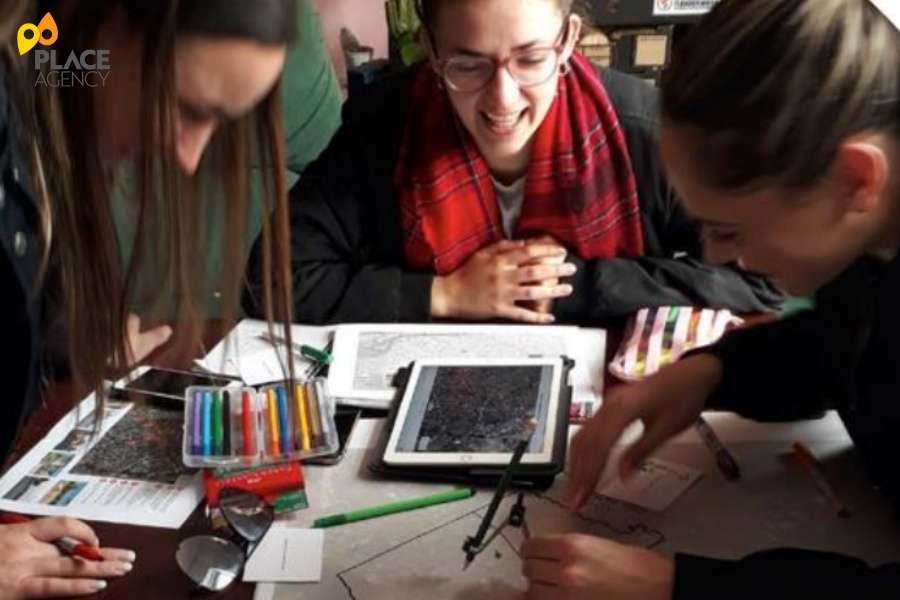
Students exploring opportunities for Bayswater
town center at the Future Bayswater Studio.
Photo credit: Robyn Creagh
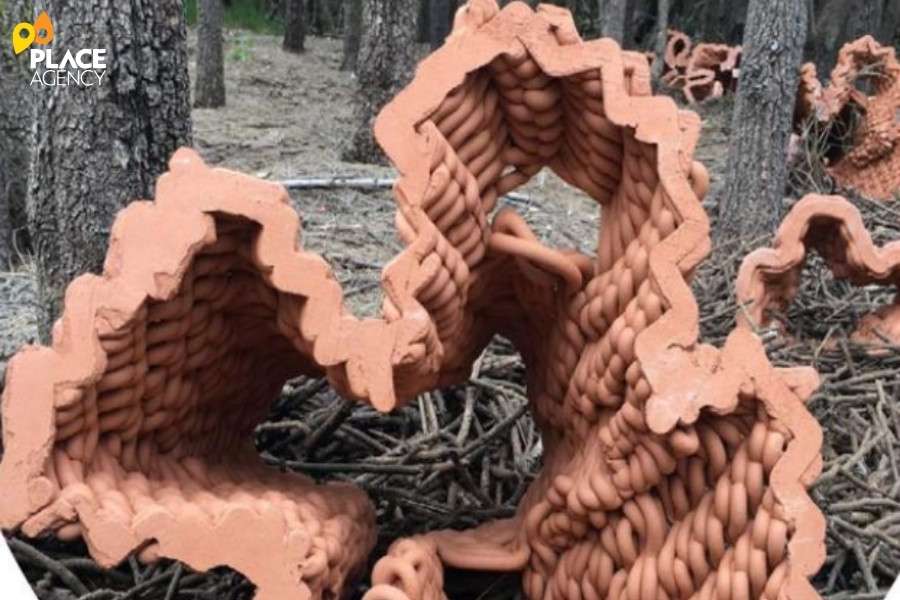
"Fishway" by Lucy Yu Hong Wang, Yiran Dong,
ZhiFei Yao from Subjunctive Space studio.
Photo credit: Joanne Kinniburgh
TRANSFORMING FOR POSITIVE CHANGE
Placemaking supports have potential health of the community, its economy and its environment, it brings energy, purpose to projects through focusing on creating relationships between people, place and the environment.
SUPPORTING PLACEMAKING IN
YOUR COMMUNITY
Place Agency has a process through which you can get a group of students (usually 10-20) involved with your project, read the case studies and connect with your local university. This aligns the project with a university, increases capacity to do engagement plus it will give you access to a pool of talent while not raising community expectation.
CULTURE AND FIRST NATIONS
Places are layered with stories from the distant, recent and emerging times, Place Agency supports the integration of these ideas and multiple studios have explored the concept of Country as a basis for site understanding and community engagement.
NATURE AND REGENERATION
Nature is critical to the wellbeing of the community. Our education program has explored strategies to reintegrate nature in placemaking practice and work on an irresistible narrative for your place.
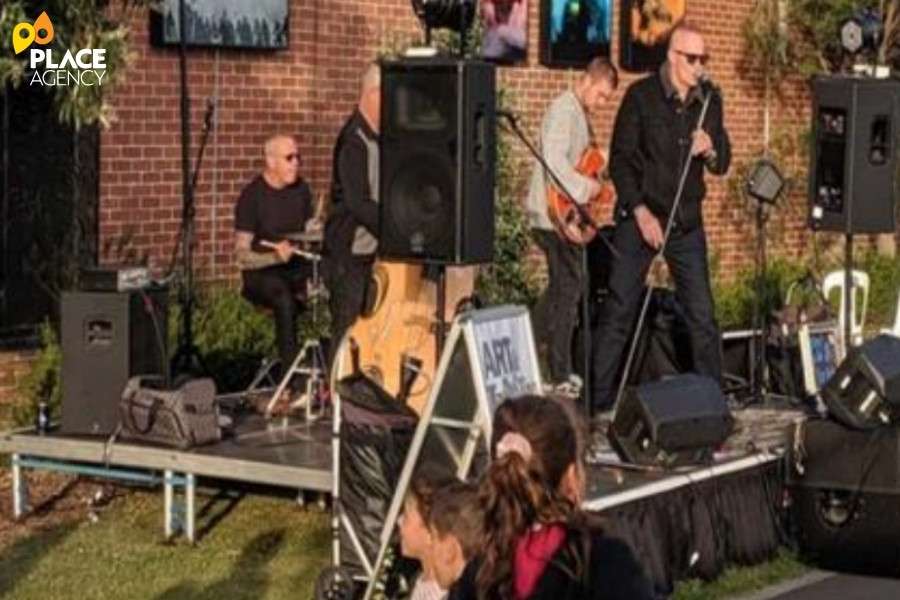
Lightbox project Launch at Newport Paine reserve (16-25th Nov, 2019). Photo credit: Dominique Hes
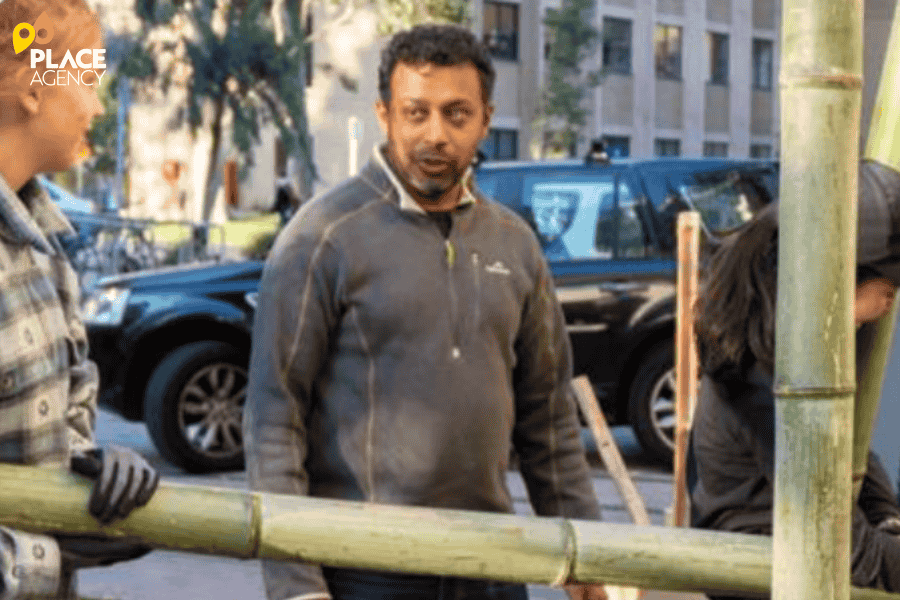
Munir Bahamati working with student to build bamboo art istanllations during the Installations and Happenings Studio. Photo credit: Alison Fong
Where do I begin?
Find an academic who works in the topics that you are interested in. The academics that have worked in any of the studios in this booklet are a good place to start.
Connect with the academic of your choice and flesh out your project of interest, needs and ideas.
Flesh out a plan that works for you and the academic both. Be clear about the expectations and the extent of the student’s involvement in your project and ensure that this is achievable within the timeline of a single semester of study term. The next pages include things that you should know before engaging in this partnership.
The next pages include things that you should know before engaging in this partnership.
HOW IS AN ACADEMIC'S
PERFORMANCE IS REVIEWED?
In our professional development reports, academics are evaluated in a range of criteria that may differ from one institution to the next. However, in general terms, we, as academics must spendapercentage of our time teaching and the rest researching. We are always interested in projects that can lead to research topics and publications. If you are willing to act as research participant, the academics will be able to spend more of their time working with you.
THE TIMELINE
While most projects can have a fluid timeline, semesters or study terms are generally well set. Again, situations may change for each institution, but a term will generally occur throughout-12 weeks in which the students delve into theoretical concepts and design concepts. Because of this, it is important to have open dialogue and specifically identify how the student’s work can contribute to a longer-term project that the community is involved in. The students cannot be expected to take a project all the way to completion but can provide fresh ideas for an area through an outsider’s lens as they simultaneously develop their own skills.
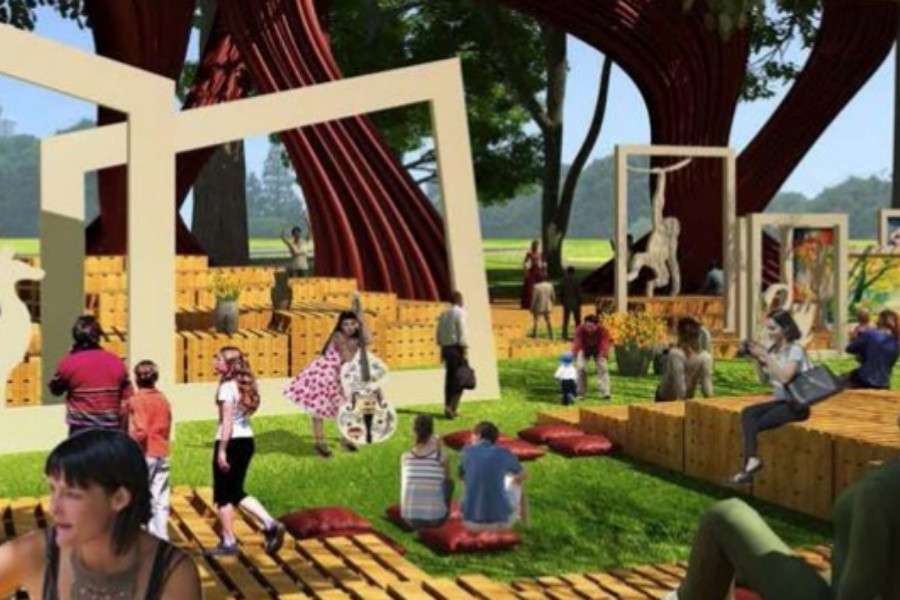
(Left) Conceptual image for the Winning design Living with Time -Tree Memorial Park by Libin Wang. (Right) Performance space at the 2019 Begonia Festival at the 2019 Begonia Festival. Temporary installation design and built by Zongjing Yu and Lihlon Libing Wang in collaboration with the Botanical Gardens. Photo credit: Zimo Wang
CLARIFYING EXPECTATIONS
Expanding on the previous point, the studios described in this booklet focused mostly on one element of the design timeline (the start). In general, studios focused on either:
designing and delivering a community engagement session and gather ideas and local knowledge insights,
creating a tactical or temporary intervention and,
delivering conceptual proposals to move forward.
Some studios offered internships to produce formal reports or deliver one of the concepts to life. These activities fell outside of the semester timeline and required further support from the project champions who took the students under their wing and gave them further experience in the professional world.
WHAT THE STUDENTS NEED
OUT OF A SUBJECT
These changes depending on the discipline, but each discipline has a series of competency requirements. Studios are the pathway that students have to build their project portfolio, thus, the end objective of the studio must help them build up on their industry-relevant skills. The academic’s first priority is to ensure that the students learn and have a positive experience within that, they will be willing to work so that the studio outcomes are useful to you as well.
BE AWARE OF WHAT FUNDS ARE
NEEDED
Practice-led studios such as these ones need a ‘seed-funding’ that allows the students to deliver the practical elements portrayed in the studio. Fundsswereere used to hire venues, buy food for community events, plan place-immersive experiences, or to get materials for student’s exhibitions, tactical urbanism implementations, etc. The price of the studios varied widely depending on the in-kind support available. Some project champions secured cost-free venues suitable for the project or provided organisational support.
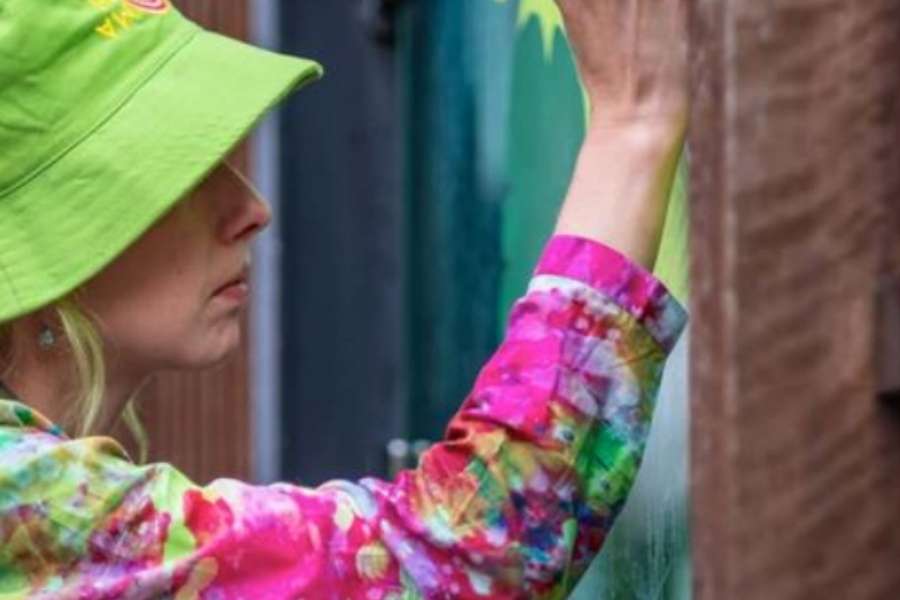
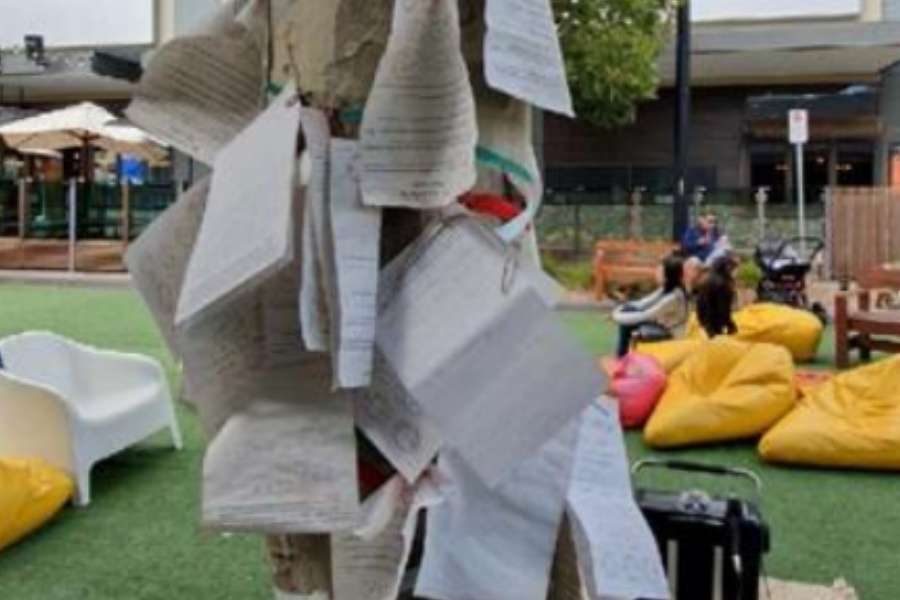
Wishing tree asaparticipatory action placemaking process al 2020 Point Cook Pop-up Park (bottom). Community's love letters to Point Cook' used as inspiration for participatory glass mural designed by emerging artist CEJ (top) Photo credit: Cris Hernandez-Santin (bottom)and David Mullins (top)
Want to learn more about the project?
This project has led to multiple publications for different audiences. Please refer to this list below to identify other documents or publications that you might be interested in:
On placemaking theory
Hes, D., Mateo-Babiano, I., & Lee, G. (2020). Fundamentals of Placemaking for the Built Environment: An Introduction. In Placemaking Fundamentals for the Built Environment (pp. 1-13). Palgrave Macmillan, Singapore.
Hernandez-Santin, C., Hes, D., Beer, T., Lo, L.,(forthcoming), Regenerative Placemaking: creating a new model for place development by bringing together regenerative and placemaking processes. In Roggema, R. Smart and sustainable built environments, Palgrave.
Dyke, R. (2020). Regenerative Placemaking as a tool for (re)igniting environmental connection and stewardship. Master Research Project. University of Melbourne.
BE AWARE OF WHAT FUNDS ARE
NEEDED
Mateo-Babiano, I., & Palipane, K. (2020). Reimagining Place Through the Sandqox Studio Pedagogy: An Introduction. In Placemaking Sandbox(pp. 1-14). Palgrave Pivot, Singapore.
Costa Cruzato, G., Hernandez-Santin, C., Macintosh, L. & I.Mateo-Babiano (2020). What we learned about placemaking pedagogy and the placemaking teaching guide.
Streatfield, A. (2020). The understanding of Placemaking. Master Research Project, University of Melbourne
Acknowledgments
We give our deepest thanks to everyone that has been involved in this project. There have been over 50 people and organisations involved at different levels of the project and it would be impossible to name them all. We first thank The Myer Foundation, who provided the funding for our consortium to add to the voice of placemaking theory and practice. It was though their vision and initiative that this project came to be. In that process, we also want to acknowledge the role that CoDesign had as a catalyst of this project. It is through their work with Myer Foundation (The Neighbourhood Project) that they first highlighted the need for capacity building in placemaking. The Myer Foundation listened to you and immediately sought ways to create long-lasting impact through education.
Then, we give our gratitude to the universities in the consortium and all the academics who worked alongside this project. The consortium includes the University of Adelaide, Curtin University, University of Notre Dame, The University of Melbourne, The University of Queensland, University of New South Wales and The University of Technology of Sydney. We acknowledge that it is difficult to work collaboratively and even more so when that collaboration is multi-institutional. The institutions allowed us to work in a different way and the academics involved in the project showed enormous passion throughout the challenges faced. You have all given your heart and sweat to each of the projects present in this booklet and it does not go unnoticed.
To guide the placemaking capabilities and content needed, the consortium was supported by seventeen highly skilled placemaking practitioners who have provided their input at various stages of the project development. These practitioners represent the following Australian organisations: Place Leaders Asia Pacific, CoDesign Studio, Village Well, Here Studio, 226 Strategic, Place Design Studio, John Mongard Landscape Architects, ASPECT Studios, City Collective, Oxigen, PIDCOCK – Architecture + Sustainability, Place SA, TPG + Place Match, MRA, Jensen + and EcoUrban. The level of involvement varied in a case by case basis but each of your institutions was instrumental in setting the direction of your project and without you this project would have looked very different.
Lastly, we would like to acknowledge all the people and institutions that partnered specifically with each of the sandbox studios present in this booklet. Naming each of the institutions would create a long list of collaborators and undoubtedly lead to accidentally missing one or two of your institutions. For the readers,we invite you to look within each of the studios where you can find the names and institutions involved. To our project campions, it is through your hard work that the studios have achieved a form of long-lasting legacy within the local community.